Sort a linen cupboard by the beds you use
Let bed size and the frequency of changes determine the arrangement.
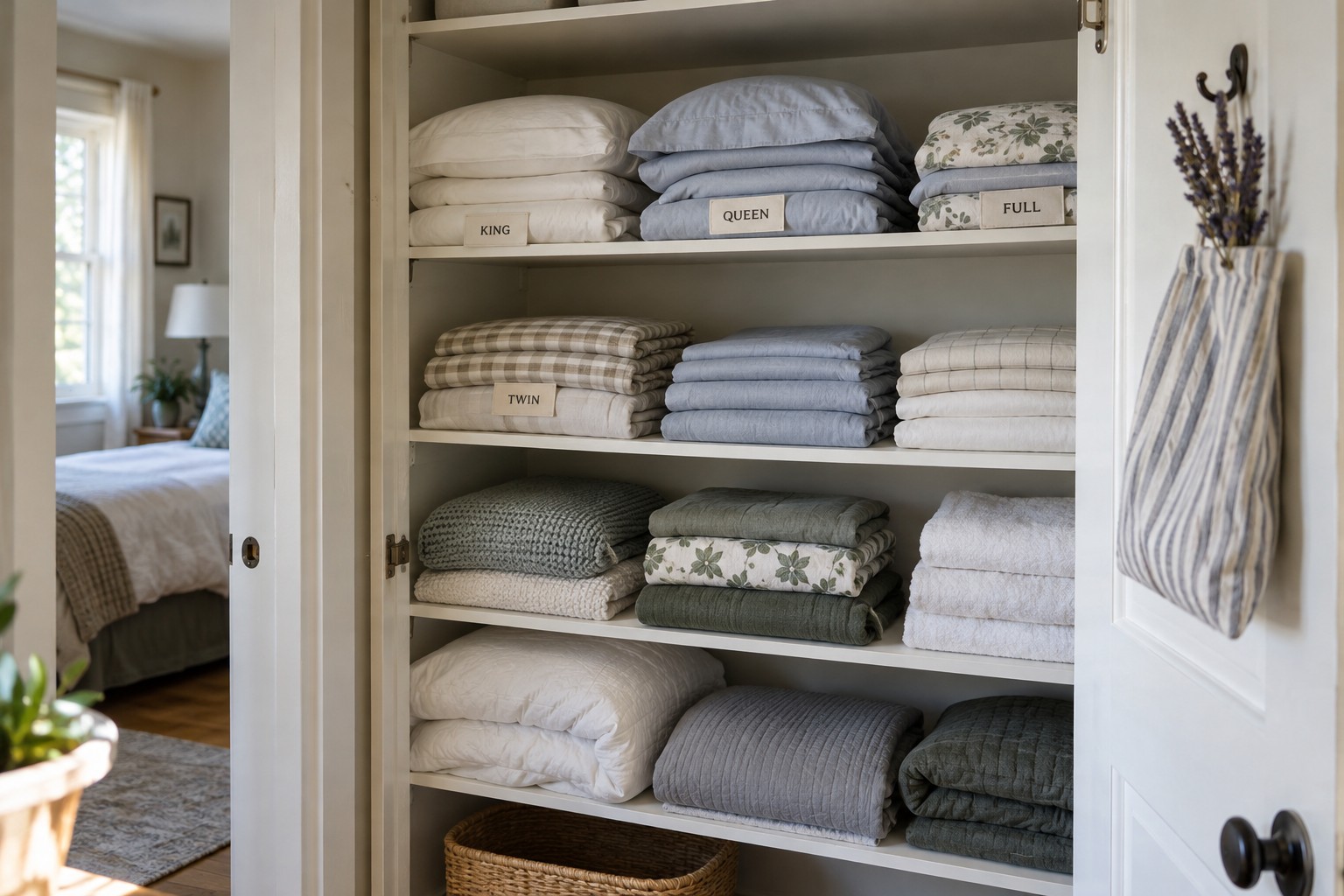
A linen cupboard becomes confusing when similar-looking sheets serve different beds. Sorting by colour alone may create attractive stacks while leaving the person changing a bed to unfold several sheets before finding the right size. Begin with the beds currently in use, then assign the bedding to them.
Take out one shelf at a time if emptying the whole cupboard would overwhelm the room. Identify the size of each sheet, cover and pillowcase from its label where possible. Put uncertain pieces aside to measure rather than guessing. Bedding for a bed you no longer own should not occupy the easiest shelf simply because it has always lived there.
Keep sets recognisable
A complete set can be folded together, held with a simple band or placed inside one of its pillowcases. Choose the method that makes sense for the cupboard's depth. Storing a set inside a pillowcase is less useful if the resulting bundle is too thick to stack securely. A shelf label naming the bed or size can remove the need to inspect every package.
Place the most frequently changed bedding at a comfortable height. Guest bedding can occupy a less convenient shelf, provided it remains reachable without pulling down unrelated stacks. Separate spare pillowcases from complete sets if they are used independently. Otherwise they tend to disappear from sets that then appear complete until the next bed change.
Make the cupboard's depth work
Deep shelves can hide a second row. If you use that space, give the rear row a clear purpose such as occasional bedding, and avoid mixing it with everyday sets. A removable basket may help bring a whole group forward, but it should be easy to lift when full. Measure before buying several identical containers.
Return bedding only when it is fully dry and follow the fabric's care instructions. Keep cleaning products elsewhere so the cupboard remains dedicated to textiles. Leave a little space above each stack for removing a set without dragging its neighbours out.
The useful quantity is personal: consider laundry turnaround, storage space and visitors rather than adopting a universal number of sets. After a few changes, notice which piles remain untouched and which are always depleted. Adjust the allocation to the beds you actually make, not the collection you happened to accumulate.
Handle shared sizes without duplicating systems
If several beds use the same size, decide whether the sets are interchangeable or assigned to particular rooms. Interchangeable bedding can share one clearly marked section, which makes laundry turnaround simpler. If colours or fabrics are deliberately assigned, keep those groups separate. Either approach works; confusion comes from switching between them without making the arrangement clear.
Make a temporary place for an incomplete set while its missing piece is in the wash. This need not be another purchased container. A small section of shelf prevents a nearly complete bundle being mistaken for a ready one. When the missing item returns, reunite the set immediately rather than allowing individual pieces to migrate into miscellaneous stacks.
For a household with two identical-size beds and one smaller guest bed, try one shared shelf for the everyday sets and a separately labelled guest bundle. Keep the matching pillowcases with each set rather than creating a single large pillowcase pile. When a set is removed, the space it leaves also becomes a clear return position after washing. If household members routinely mix particular fabrics or colours, label those combinations by room instead. The better system is the one that removes uncertainty during a bed change, not the one that produces the most uniform stacks.
Seasonal bedding can move higher or lower as its use changes. Before moving it, check its condition and the space it actually requires. Bulky items may need a different storage location from sheets, and compressing them tightly is not suitable for every material. Follow their care and storage guidance rather than choosing a vacuum bag solely because it appears to save space.