Keep a jigsaw puzzle going in a shared room
Give an unfinished jigsaw a stable footprint that does not take over every shared surface.
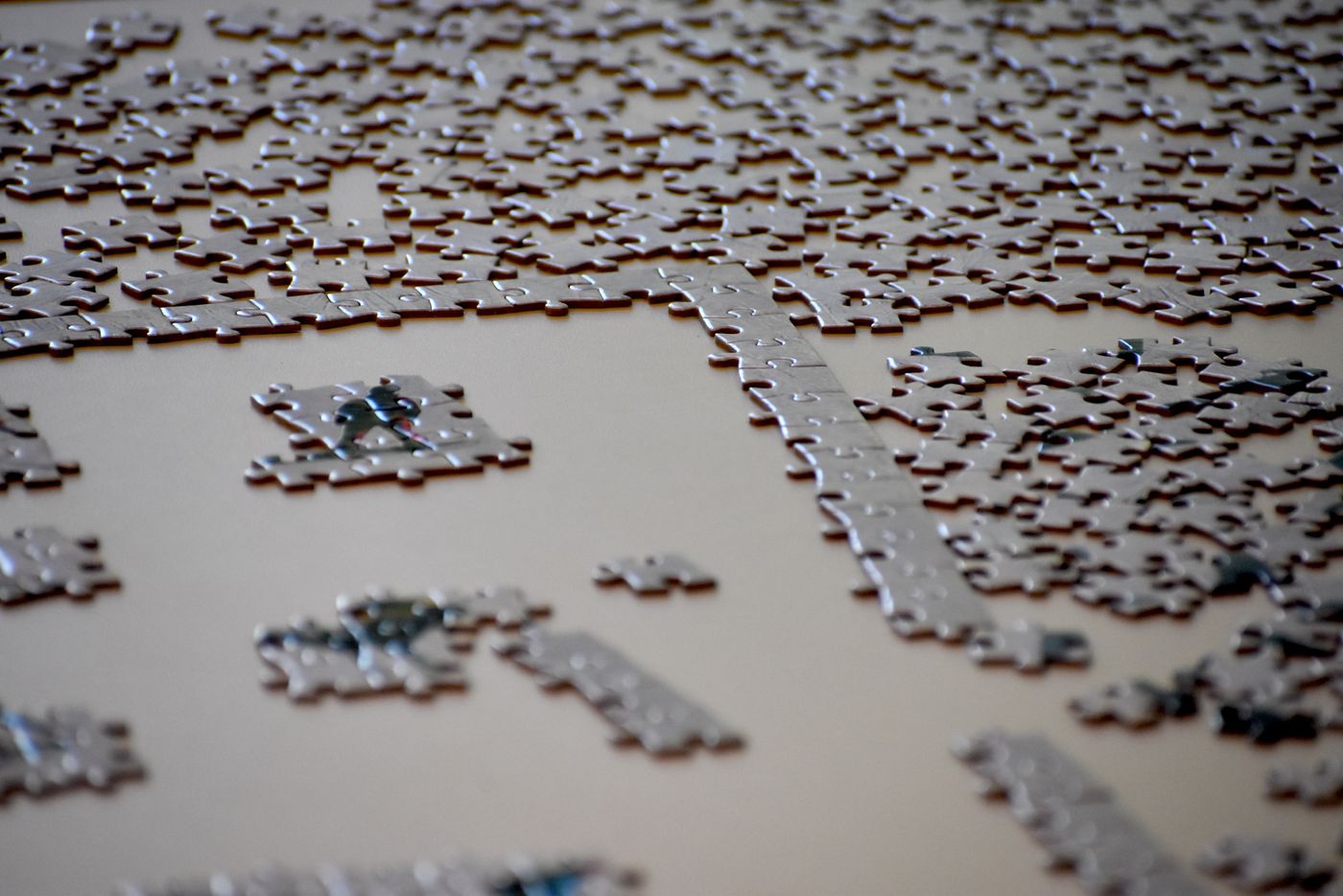
A jigsaw puzzle needs two kinds of space: room for the completed picture and room to sort pieces while working. Check the finished dimensions on the box before choosing a board or table. Add usable space around that rectangle, especially if several people will work on it together. A puzzle that technically fits but leaves no room for pieces can be frustrating.
Choose the temporary home
If the dining table must be cleared, use a suitable puzzle board or another rigid support that can be moved safely. Check its weight when loaded and where it will be stored. Sliding a large board under furniture may not be practical if it requires tipping it or lifting it alone.
A roll-up mat is a different arrangement from a rigid board, and results depend on the product and puzzle. Follow its instructions rather than assuming every piece will stay perfectly aligned. Test with a small assembled section before relying on it for a nearly finished puzzle.
Make sorting visible
Use shallow trays or lids for groups of pieces. Sort by recognisable areas of the picture, texture or colour as well as edge shape. A complicated image may need several overlapping approaches; there is no obligation to begin with the entire border if another section is easier to recognise.
Keep the box image visible without occupying valuable working space. Agree where loose pieces belong so that household members do not mistake them for scraps. Protect the setup from pets, young children and objects likely to be placed on top of it.
Define shared-room boundaries
Choose times when the puzzle can spread out and times when it must return to its footprint. A nearby tray can hold sorting work temporarily, but spreading onto the kitchen counter merely transfers the problem. If the available space is limited, select a smaller puzzle rather than requiring the room to serve only one activity.
Before packing away each session, check the floor and surrounding seats for dropped pieces. Put trays and reference material together. A missing piece discovered early is easier to locate than one lost through several rounds of cleaning.
Decide what will happen when the picture is complete. Photographing it, leaving it for a day or returning it to the box are all reasonable finishes. Unless you genuinely want to preserve it, completion does not have to create a new storage project.